Xi'an
Geographically, the Qinling Mountains–Huai River line is considered China’s north-south dividing line!
A colleague came back from Inner Mongolia, bragging about eating lamb on the steppe. Another returned from Shanxi, describing the enormous snow there. Then it occurred to me that the northernmost place I’ve ever been is Mianyang. I ground my teeth, frustration welling up in my chest.
Actually, I did once take the Qinghai-Tibet Railway: Lhasa → Xining → Lanzhou → Xi’an → Chongqing, making a grand loop across western China — 3,654 kilometers. If I were a tribal chieftain, a quarter of that territory would be mine. Unfortunately, I never stopped anywhere along the way.
On the first day of the Lunar New Year, there’s a family tradition: my mother-in-law goes up the mountain to worship Buddha. So no cooking at noon — everyone’s on their own.
That’s how my four siblings and I ended up embarking on a spur-of-the-moment trip.
We only planned to visit Guangwu Mountain in Bazhong and come back the same day.
And then we crossed mountain after mountain, pushed through crowds of people, and finally arrived at Guangwu Mountain.
Guangwu Mountain sits at around 2,000 meters in elevation. The roads are rough — countless S-shaped winding mountain roads, made worse by light rain, potholes, and splashing mud. My car may look like an SUV, but it’s really a city runabout, and I hadn’t even installed an engine guard plate. It broke my heart.
The climb required gaining over 1,000 meters in elevation, using third or fourth gear all the way to the top. Everything was covered in white — not snow, but ice glazing the tree branches, looking exactly like this. We found a flat stretch of road to take a few photos, but everyone was shivering and huddled together, frozen to the bone.
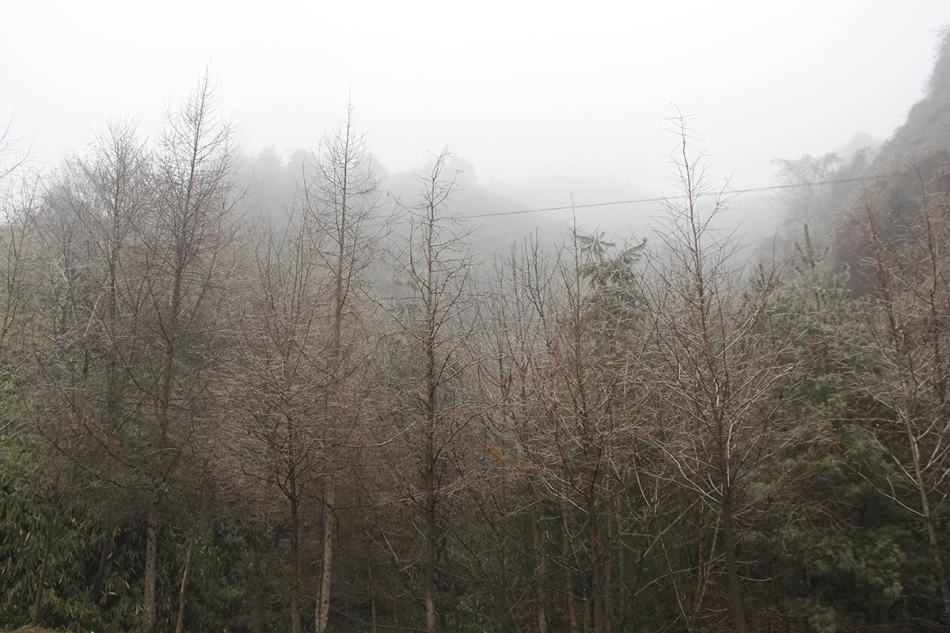
Next to Bazhong is Hanzhong. I hadn’t realized Guangwu Mountain sits right on the provincial border. Since it was the first day of the Lunar New Year, Guangwu Mountain Town was practically deserted — not a single tourist to be seen. Terrible timing. I asked my siblings: “Two hundred kilometers ahead is Hanzhong. Two hundred kilometers behind is home. Want to keep going north?” Who turns down an adventure? Unanimous approval! So we drove on.
Not long after heading north from Guangwu Mountain Town, we reached the provincial border. This spot may not be as epic as the Sichuan-Tibet border crossing, but for my two siblings who had never left the province, it was highly symbolic.
Crossing the border meant entering Shaanxi territory and hitting a steep downhill stretch. Visibility dropped to less than ten meters. I turned on my hazard lights, crawling at 20–30 km/h. That’s when I learned that even 20–30 km/h is dangerous in heavy fog — especially when you don’t know there’s a car ahead making a U-turn, its side suddenly facing you. Slam on the brakes! Scared the hell out of me.
After that long downhill stretch, the fog lifted, visibility opened up, and we entered the Hanzhong Plain — a land of plenty for a group of Shaanxi people who speak Sichuanese dialect.
By the time we reached Hanzhong’s city center, it was already 4 PM. Having finally arrived somewhere new, we couldn’t pass up the food. We circled the city twice before finding a snack shop. Even though it was New Year’s Day, plenty of people were eating — tables had spilled out onto the street. Hanzhong’s specialty is hot liangpi (cold skin noodles). The name sounds contradictory, but it comes from the preparation method: you steam a flour-based batter, then serve it with cold broth. Refreshing and uniquely delicious.
Then we faced another awkward dilemma. The original plan was to head home from Hanzhong. But Xi’an was right there, just 220 kilometers north. Home was south, 400 kilometers away. What to do?
You already know the answer — keep going north. To the real, geographically proper North.
Getting from Hanzhong to Xi’an means crossing the Qinling Mountains — over 200 kilometers, with 130 kilometers of mountain highway. Used to Sichuan’s expressways, I was shocked to find the entire Han-Xi expressway limited to 100 km/h. Extremely frustrating. But the real annoyance was yet to come: a traffic jam inside a tunnel!!! Over just 200+ kilometers, it took us four hours.
True to its reputation as a geographic divide, shortly after exiting the Qinling Tunnel No. 3, bam — the Guanzhong Plain stretched out before you! Like an Italian pizza suddenly dropping on the ground, it was that surprising. The roads straightened out instantly, the radio signal cleared up, and we were cruising at 120 km/h!
If not for visiting the Muslim Quarter, the Bell and Drum Towers, my impression of Xi’an would have been just so-so — a few more grand city walls and historic sites than average. But the moment I stepped into the Muslim Quarter, Xi’an instantly became legendary in my mind, as awesome as Nanning.
Any city with a dedicated food street in its center is awesome. Chengdu lacks exactly this, which is why I find Chengdu boring — I don’t know what outsiders are talking about when they rave about Chengdu’s food scene. Hot pot, maocai, skewers, BBQ, Sichuan cuisine — everything is blazingly spicy. And yet, you still complain while eating. But in the Muslim Quarter, surrounded by all my favorite wheat-based foods — biangbiang noodles, mutton paomo, wide belt noodles — I was so happy my bones were bubbling. So the siblings and I ate our way through the entire street until we were stuffed.
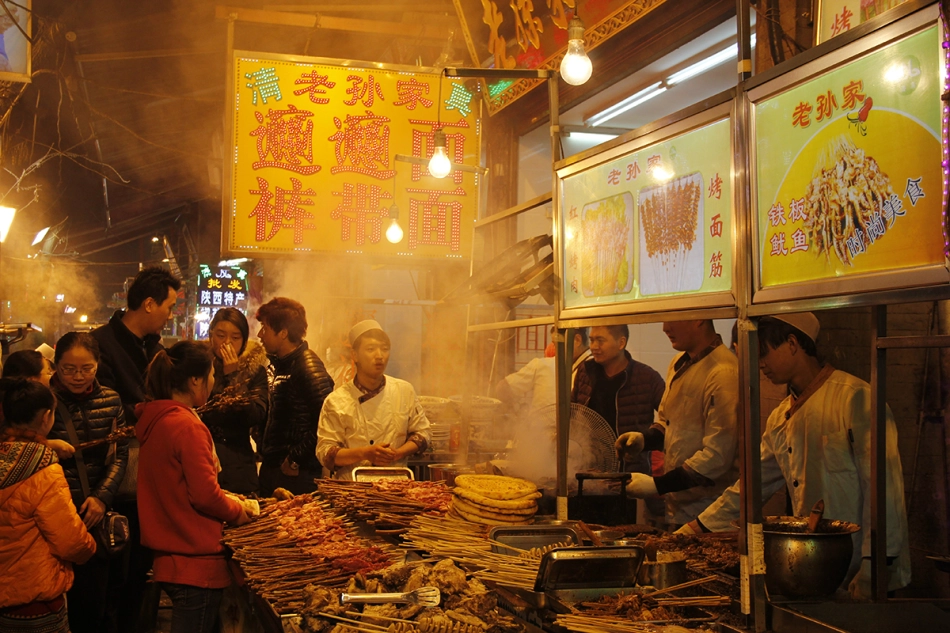
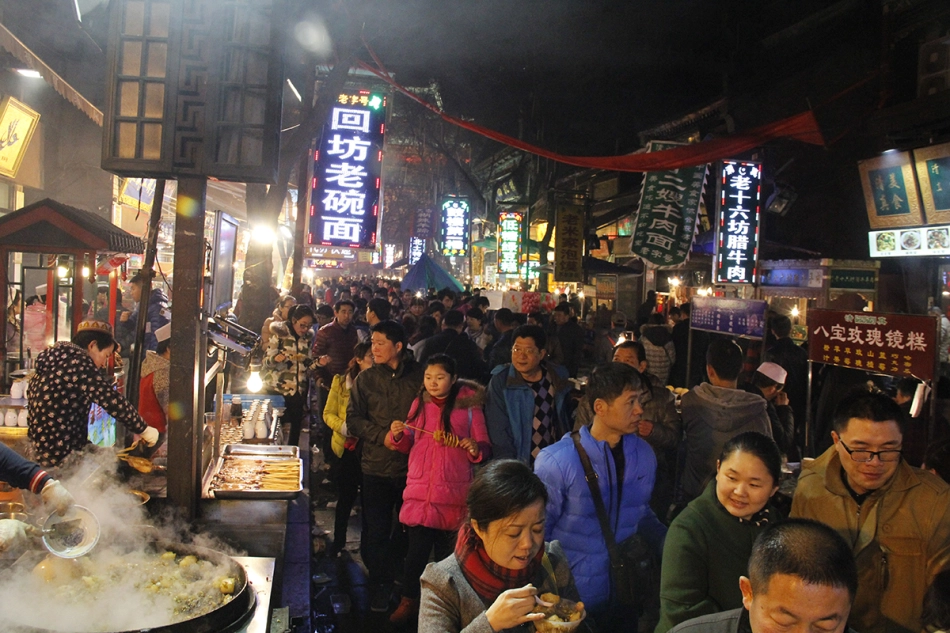
With tight time constraints, we had to return to Nanchong the next day, so we couldn’t visit many of Xi’an’s attractions. We wandered through the Muslim Quarter again at noon, bought a big bag of provisions, and drove back home on the expressway the whole way — seven hours, only 270 yuan in fuel for the one-way trip. [THE END]