Can Humanity Achieve Interstellar Travel?
I’ve watched Interstellar three times over and over again. The entire film’s theoretical framework is built on relativity and wormhole theory. Fascinating as it is, I still feel that the level of technology depicted in the movie (and in real-world society) is hopelessly inadequate. Without the wormhole placed near Saturn by future humans, there’s virtually no chance for humanity to fly out of the solar system with our current technological capabilities.
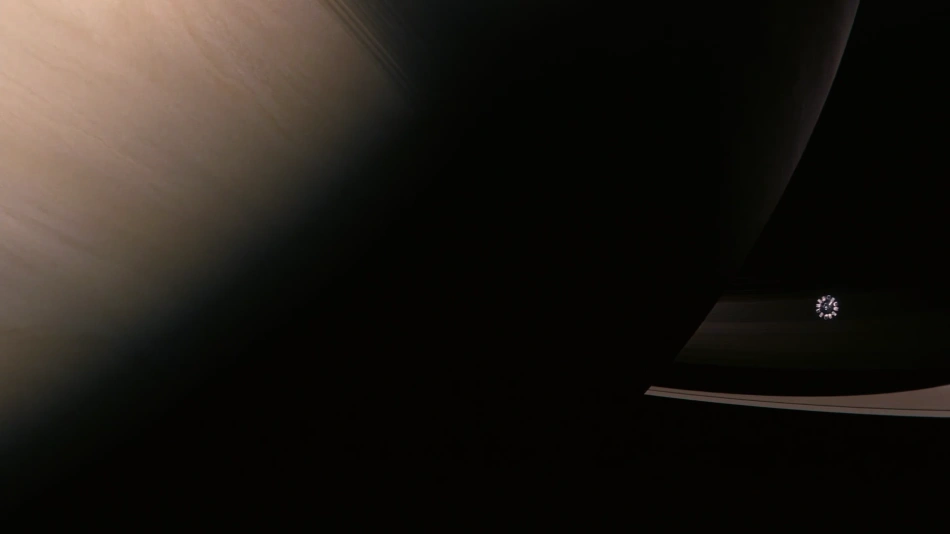
Voyager 1 is probably the fastest machine humanity has ever built (currently exceeding the third cosmic velocity of 16.7 km/s, though its exact speed is unknown). In 2013, NASA announced that Voyager 1, launched in 1977, had finally exited the heliosphere — the region influenced by solar particles — and entered interstellar space. At the time, I naively thought the solar system must be small enough to cross in just 35 years. In reality, the distance Voyager 1 covered in those 35 years is equivalent to the smallest graduation on a micrometer when compared to the scale of the entire solar system.
How Big Is the Solar System, Really?
Any celestial body or material orbiting the Sun falls within the solar system’s boundaries. Besides the eight well-known planets, there are at least five dwarf planets, at least 173 moons, and hundreds of millions of smaller bodies. Beyond Neptune lies the Kuiper Belt — a disk-shaped region composed of numerous planetesimals, extending roughly 50 to 500 astronomical units from the Sun (one astronomical unit being the distance between Earth and the Sun). Beyond the Kuiper Belt lies a spherical cloud enveloping the solar system called the Oort Cloud, situated 50,000 to 100,000 astronomical units from the Sun, with a maximum radius of about one light-year.
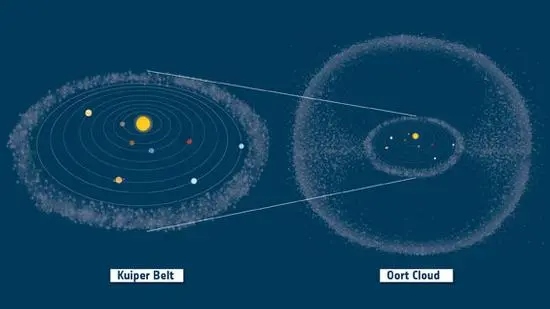
Only after passing through the Oort Cloud can humanity truly claim to have left the solar system. Yet Voyager 1 took 35 years to travel just over 120 astronomical units — less than 4 AU per year. A simple division makes it clear: even at Voyager’s current speed, humanity would need at least 20,000 years to exit the solar system.
Human Technology Is Seriously Underwhelming
Over the hundreds of thousands of years since humanity’s emergence, every technological leap has meant an increase in our travel speed — with the most dramatic improvements occurring within the last 200 years. Unfortunately, propellant-based propulsion appears to have hit its ceiling. Today’s rockets aren’t fundamentally different from those of 50 years ago. According to the mass-energy equivalence E=mc², to achieve greater speeds, we need greater reverse thrust, which requires carrying more energy and achieving higher exhaust velocities. For a high-speed short trip within the solar system, the fuel and engine mass required would far exceed that of the crewed spacecraft itself.
So interstellar travel via propellant propulsion is simply impossible — unless we have tens of thousands of years or a practically infinite energy supply to burn through.
If we rely solely on the technology we have today, humanity will forever be playing in the mud at the innermost edge of the solar system.
Our goal is the stars and the sea! Humanity needs a new propulsion method: propellantless propulsion.
There are currently about a dozen propellantless propulsion concepts — solar sails, electromagnetic propulsion, nuclear fusion drives, warp engines, and more.
A solar sail works much like a sailing ship: an enormous thin film is deployed in space with a spacecraft trailing behind it. Photons from sunlight strike the film, generating reverse thrust. As long as the craft doesn’t decelerate, it will keep accelerating until it reaches extraordinary speeds. The biggest hassle with solar sails, however, is deceleration. Traveling from one star to another star of comparable brightness, you can decelerate mid-journey using the target star’s light. But if your destination is a non-luminous body, you’d need either propellant-based deceleration or gravitational braking — both tricky in practice.
Electromagnetic propulsion uses electromagnetic fields to control the direction of particle ejection, steering spacecraft along predetermined trajectories. It’s energy-efficient and compact, and some satellites already use this technology for orbit stabilization.
Nuclear fusion propulsion is another form of propellantless drive. It’s been estimated that to accelerate 11,000 tons of mass (roughly the weight of a small naval vessel) to half the speed of light, you’d need all the helium-3 on the Moon to sustain a controlled fusion reaction. Obviously, that’s not feasible — and we haven’t even fully mastered controlled nuclear fusion yet. But using it for short trips at 1% to 10% of light speed would be quite comfortable.
Anyone who has read The Three-Body Problem or watched Star Trek is surely intrigued by the warp drive. A warp engine could accelerate a spacecraft to light-speed conditions almost instantly without altering relative time — a truly advanced propulsion concept. But a concept is just that: so far, no scientific research has been able to prove its validity.
It’s clear that the next generation of spacecraft may adopt electromagnetic or nuclear fusion drive technology. There are countless challenges to overcome — and beyond physics, materials science, biology, and many other disciplines will require the collective effort of all humanity.