2025 Vietnam-Guangxi-Yunnan Road Trip
August in Chengdu was blazing hot — the ground felt like it was warping from the heat, and being outdoors was no different from ascetic practice. So after my kid graduated from kindergarten, she was stuck at home all day. Whenever she was thoroughly bored, she’d always ask me: “Dad, what else can I play?”
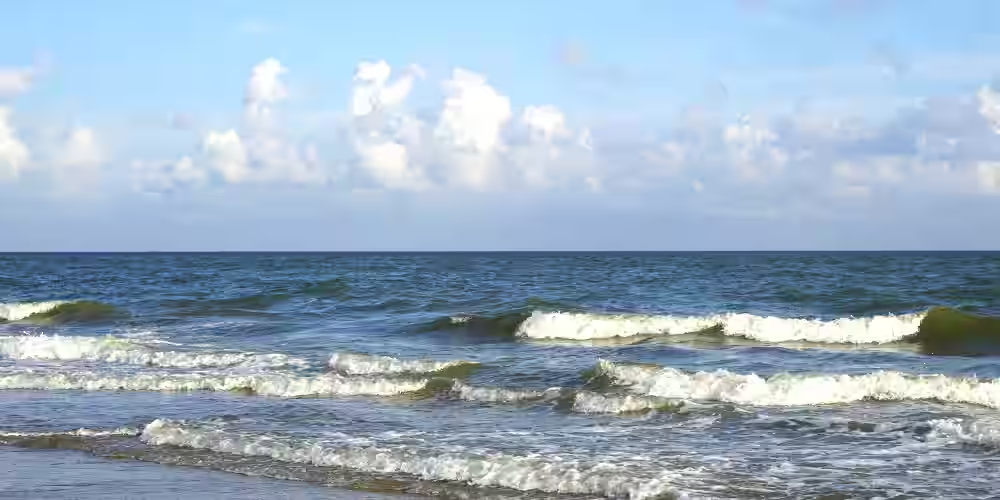
I knew exactly what she meant — she wanted to watch TV. So I said, “How about our whole family goes to the beach!”
And just like that, we went. The route for this trip wasn’t specially planned — we had just two goals:
First, burn through the rest of summer vacation outside. Second, we had to go to the seaside.
No detailed itinerary — wherever was fun, we’d stay and play. Going from Chengdu to the eastern coast was far too distant, and the seawater wasn’t clean anyway. Guangxi was a simpler choice. First stop: Fangchenggang. Second stop: we’d decide after we finished the first.
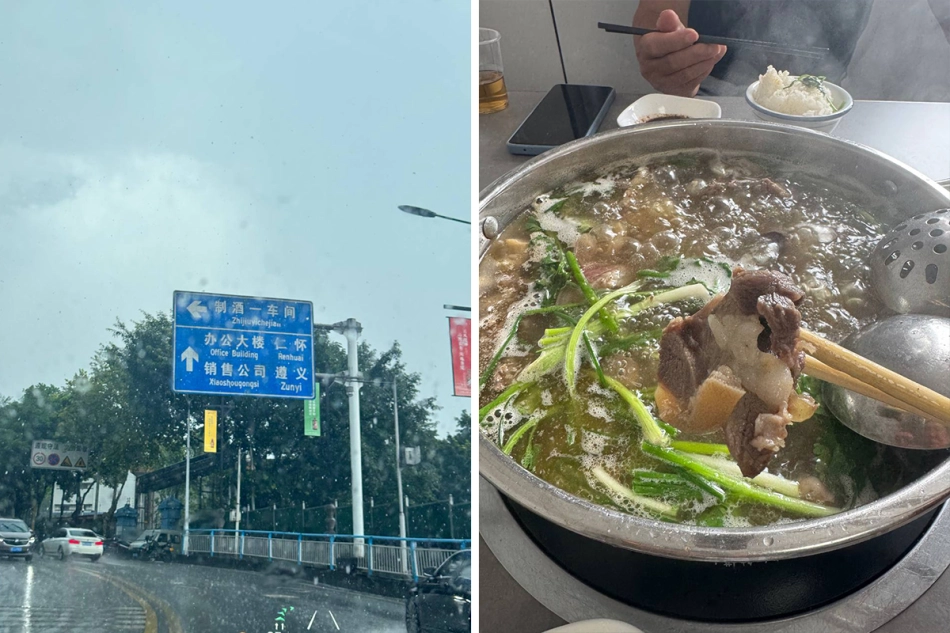
We departed Chengdu at 8:30 AM and arrived in Maotai Town by 1 PM. We spent an hour and a half there eating lamb with the skin on, and also got caught in a sudden thunderstorm. We kept driving until 6:30 PM — it had just gotten dark — and stayed in Luodian County, the last county before leaving Guizhou. The next day we set off again at 8:30 AM and by 2 PM we had arrived in Fangchenggang.
Dongxing and Mong Cai, Vietnam
The sky was drizzling, and Fangchenggang’s inner sea was murky. I remembered back in ‘23 when we went to Zhuhai, the kid saw the yellow ocean beside Jinwan Airport and said, “Dad, that’s not the sea — seawater should be blue.” To show her a truly blue ocean, we first went to the popular Bailangtan (White Wave Beach) scenic area. The overcast weather drained the ocean of its color, but this time the kid wasn’t depressed about it at all. She found shells on the beach and happily spent the whole afternoon picking them.
For the next few days we stayed in Dongxing City. We were already at the national border — it would’ve been a shame not to get an exit stamp in the passport. Getting a temporary visa here was incredibly easy — a little over 200 yuan per person, issued the same day. When entering Vietnam with a temporary visa, you had to surrender your passport to them, and they’d return it when you came back to China. Without our passports, we could only explore within Mong Cai.
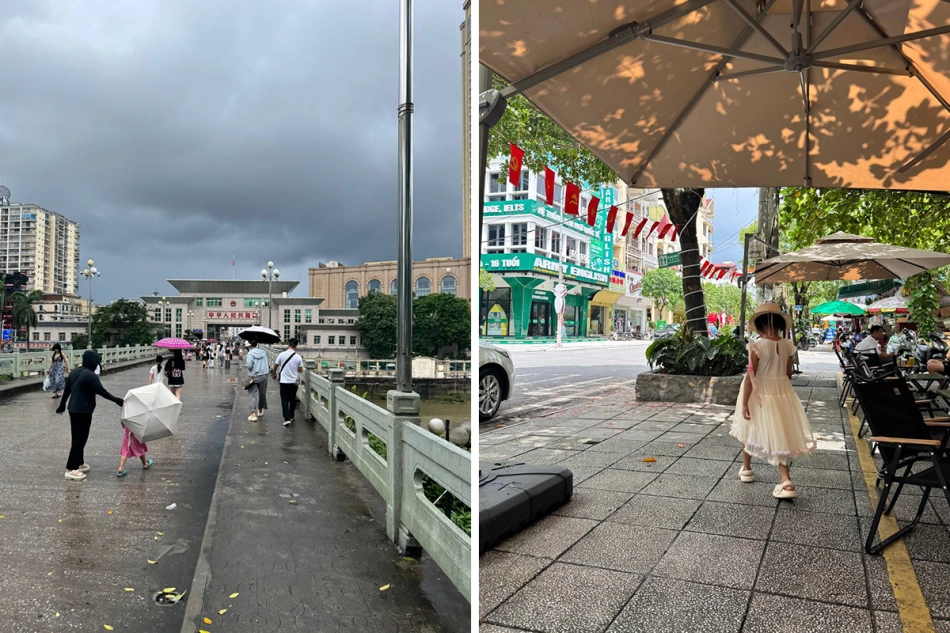
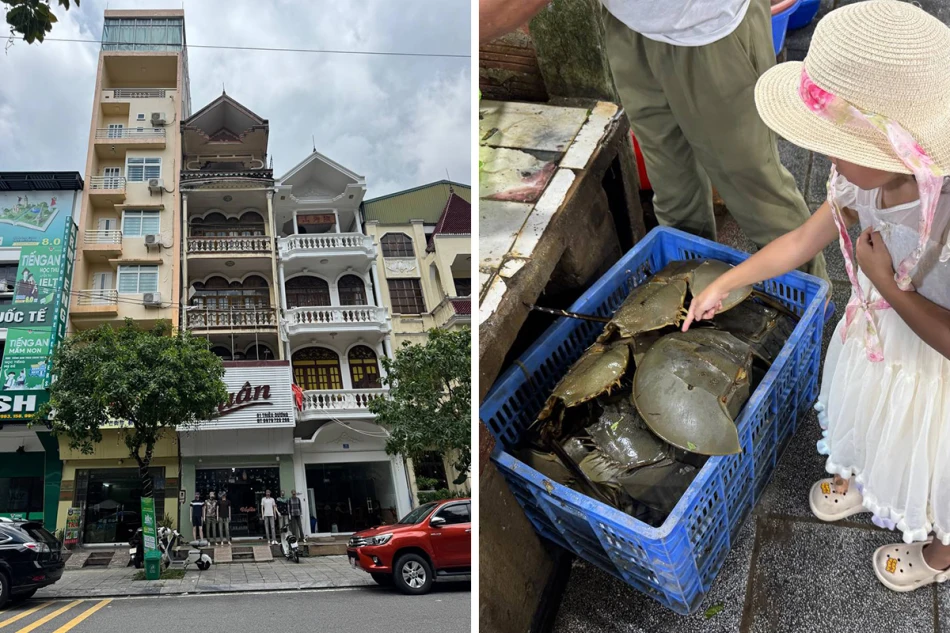
Entering a new country, I thought the kid would be at least a little curious to explore. But after a ten-minute City Walk through Mong Cai, she got bored and asked when we were going back to Dongxing — she wanted to play at the beach. So for this brief Mong Cai itinerary, I quickly tried to imprint the image of Vietnam on her: the ubiquitous single-star red flags, tall and narrow houses, brightly painted murals on walls, roads jam-packed with deafening motorbikes, Vietnamese drip coffee, conical hats, and even Chinese horseshoe crabs (a protected species in China) being slaughtered at the market.
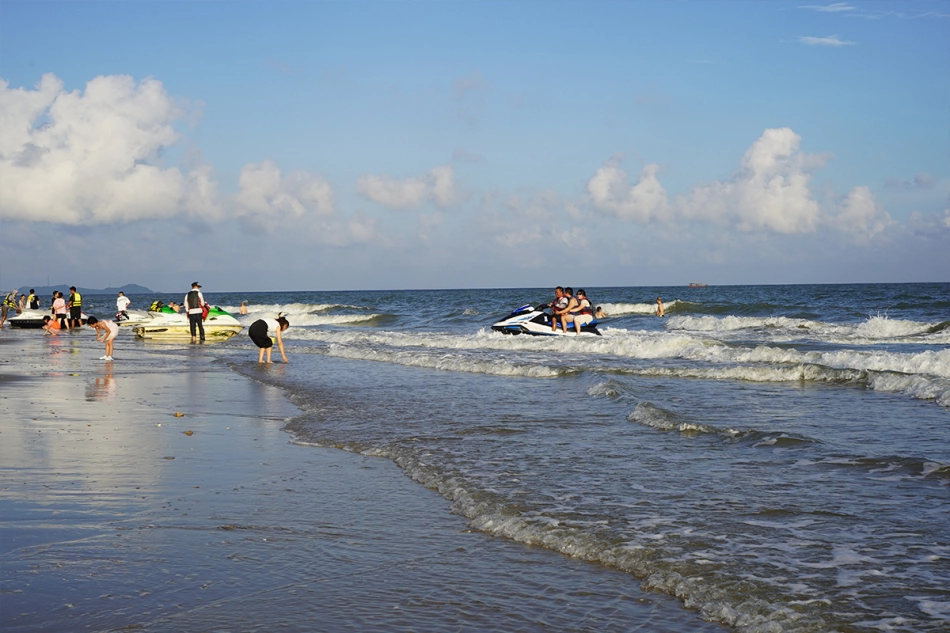
At noon we returned to Dongxing and drove to Wanwei Golden Beach. Just as we arrived, the sun was setting. The golden beach bathed in the afterglow fulfilled every imagination we had of the sea. Waves lapped against the extraordinarily long sandy shore, fishing boat motors chugged lazily back to port, and the distant sunset cast dazzling golden edges through dark clouds on the horizon. It was so beautiful we decided to just stay at Golden Beach.
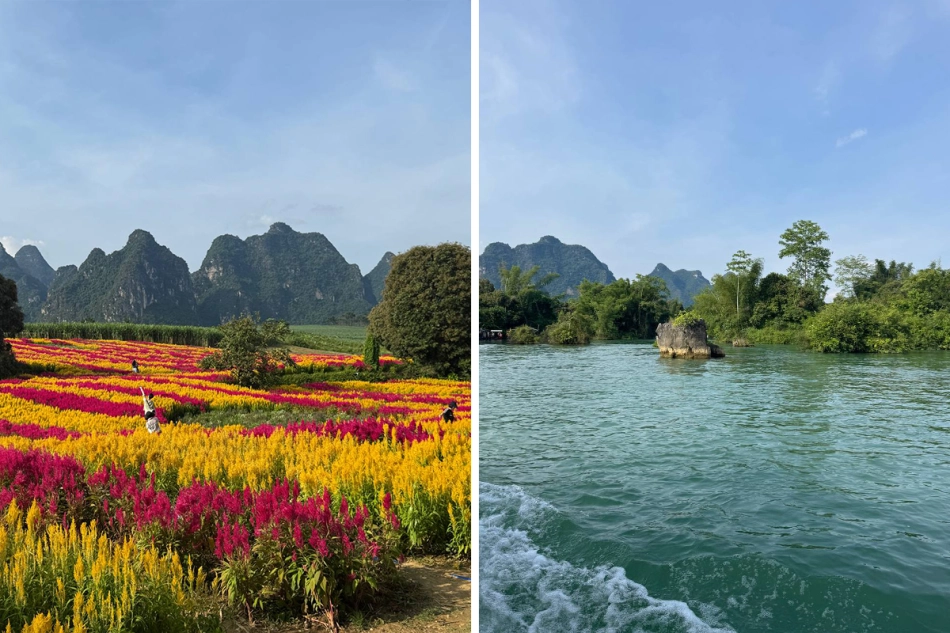
Dongna Yuwan and Detian Waterfall
After two days of digging sand at Wanwei Golden Beach, we were getting a bit tired of it. We set off for Guangxi’s second attraction, Dongna Yuwan. It’s a pastoral landscape located in Chongzuo, not far from the surrounding Mingshi Pastoral area and Detian Waterfall — all visitable together. Dongna Yuwan takes about half a day to explore, so we arrived around noon, played in the afternoon, and then went directly to stay inside the Detian Waterfall scenic area so we could enter early the next morning.
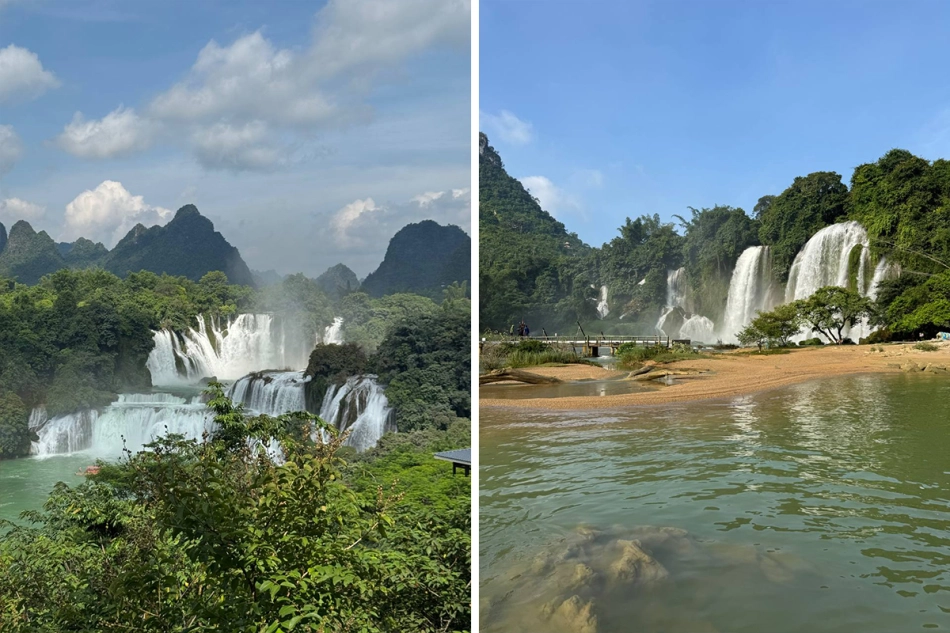
Detian Waterfall belongs to both China and Vietnam. On our side, it’s built up with all the amenities you’d expect from a Chinese scenic area — crowded with an endless stream of tourists. On the Vietnamese side, it’s like a wild, undeveloped spot — the roads aren’t even paved, visitors are sparse, and the few people there looked like they were selling cigarettes.
Jingxi County Town
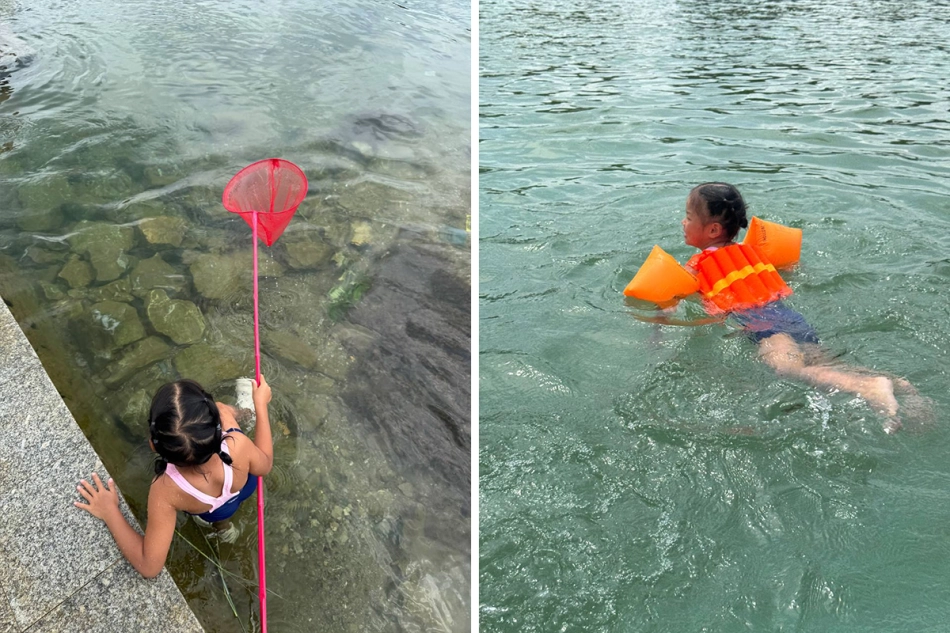
Summer in Guangxi is a paradise for water play. Leaving Detian Waterfall, the road to Jingxi County town passed several natural waterfalls where you could stop and play. We specifically chose a hotel in Jingxi County town right next to Dalongtan Reservoir. This reservoir is particularly interesting — it was originally an underground river over 10 kilometers long that burst to the surface here, forming a natural pool. Later, artificial embankments were built, creating a 750-mu reservoir. Because of the enormous water volume, the overflow from the dam formed a spectacular waterfall. What’s even more incredible is that the riverbed downstream of the waterfall is actually tiled — it’s a natural waterfall swimming pool!
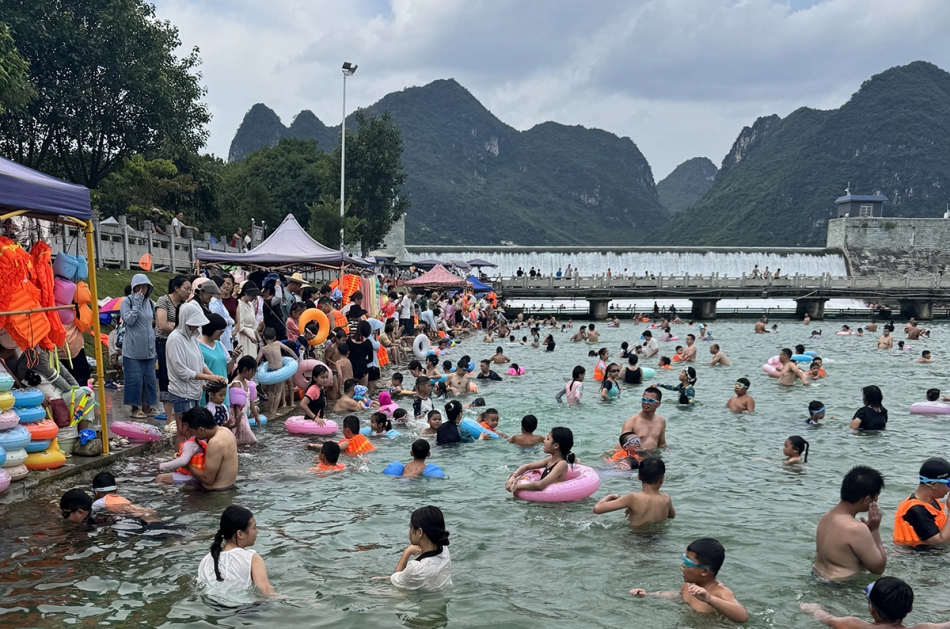
Perhaps the water was too clean — when I brought the kid to play, I saw some mint leaves floating by. Looking up, I saw the BBQ vendor on the dam washing vegetables right in the river! The swimmers nearby didn’t object either — they must have been used to it, after all, this is also the drinking water source for Jingxi County. So when I saw my kid drinking river water and spraying it around while swimming, I gave up on scolding her. Just play, just play!
Xishuangbanna
After two days in Jingxi County, we’d already been in Guangxi for a week. I was getting a bit homesick, but Chengdu hadn’t cooled down yet, so we couldn’t go back. Our next stop was somewhere slightly closer to home — Xishuangbanna.
Jingxi County to Xishuangbanna was over 900 kilometers, requiring an overnight stop in Jianshui Ancient Town before arriving the next day. In August, Jianshui’s evening temperature was only 25 degrees — a cool breeze brought a refreshing chill. We found a Yunnan wild mushroom hotpot restaurant in the ancient town, which naturally included jian shou qing (see-hand-green mushrooms). The kid was worried about seeing “little people” (hallucinations) after eating them, and hesitated with every bite. The next day I asked her, “Did you see any little people?” She smiled sheepishly.
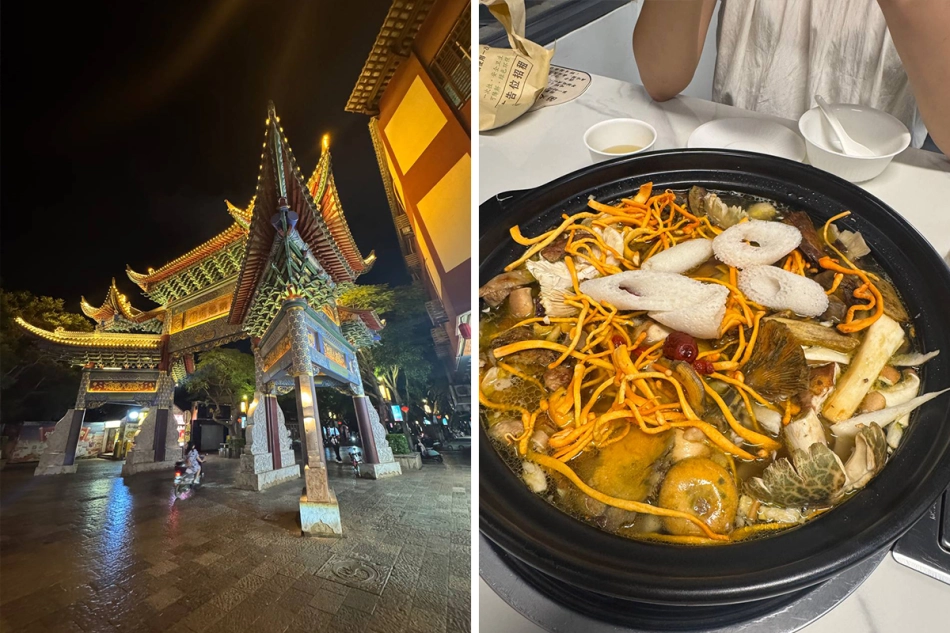
The road from Jianshui to Xishuangbanna was mountainous and steep. The expressway had no auxiliary lanes, making autonomous driving virtually impossible the whole way — exhausting. Fortunately, the best reward a journey offers a traveler is knowing that beautiful scenery and delicious food await ahead. Thinking about that, excitement returned!
At the very first checkpoint in Xishuangbanna, the tropical rainforest gave us a little shock: while we were queued up in the car waiting for inspection, a sudden thunderstorm snapped a roadside tree in half — it missed my car by just a few meters. A close call. A few kilometers past the checkpoint, we found the ground was completely dry, with no trace of rain at all.
Arriving in Xishuangbanna near dusk, walking through the bustling streets, seeing car after car with northeastern license plates, I momentarily thought I’d arrived in Dongbei. Later we even checked into a hotel run by people from Dongbei and ate Xishuangbanna’s local snacks cooked by Dongbei people.
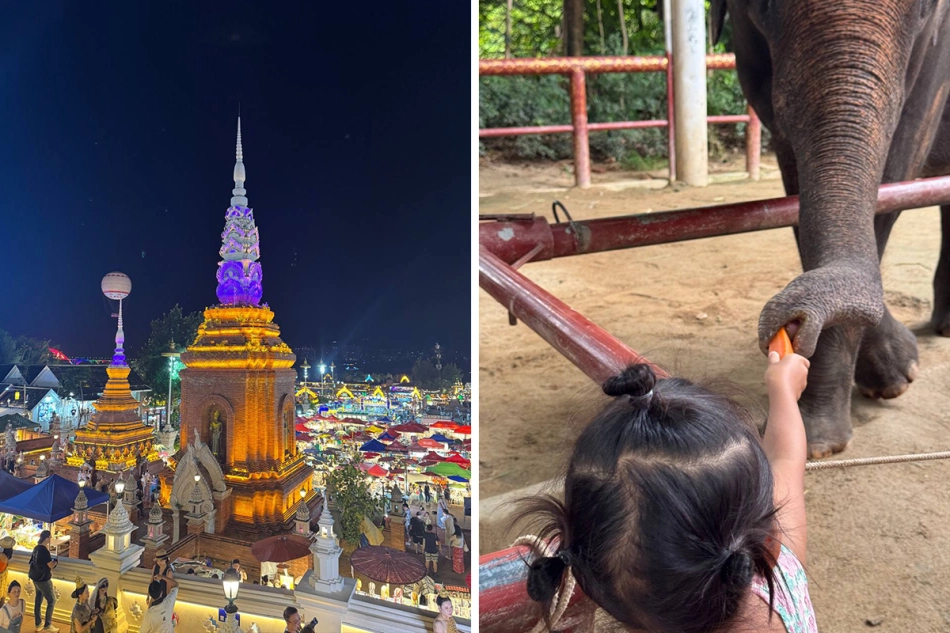
Xishuangbanna’s defining feature might not actually be Dai culture. Take the Starlight Night Market, for instance — its architectural style is no different from Thailand’s. Tourists fill the streets and alleys. No passport needed, no need to go abroad, no risk of organ harvesting, and you can still experience Thai vibes — pretty good. But I’d recommend avoiding the local bizarre-looking street food — not sure where we picked something up, but our kid got diarrhea and we had to go to the hospital in the middle of the night.
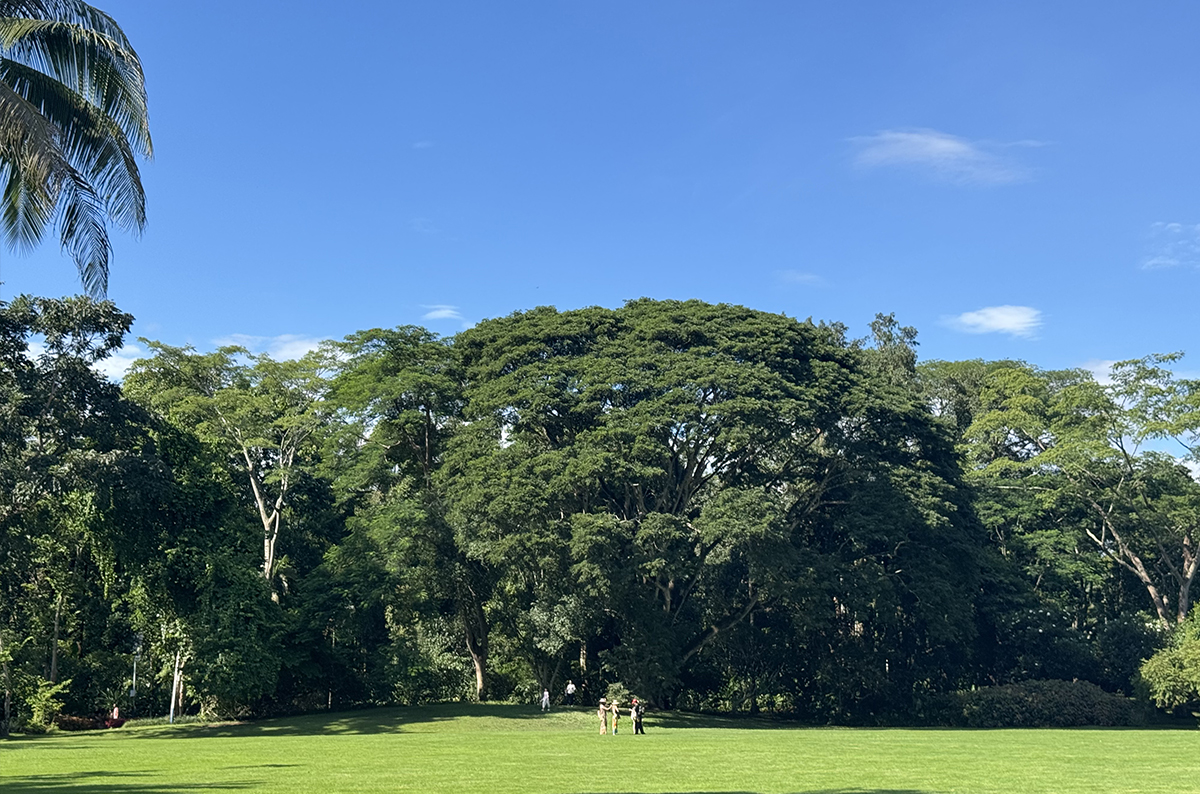
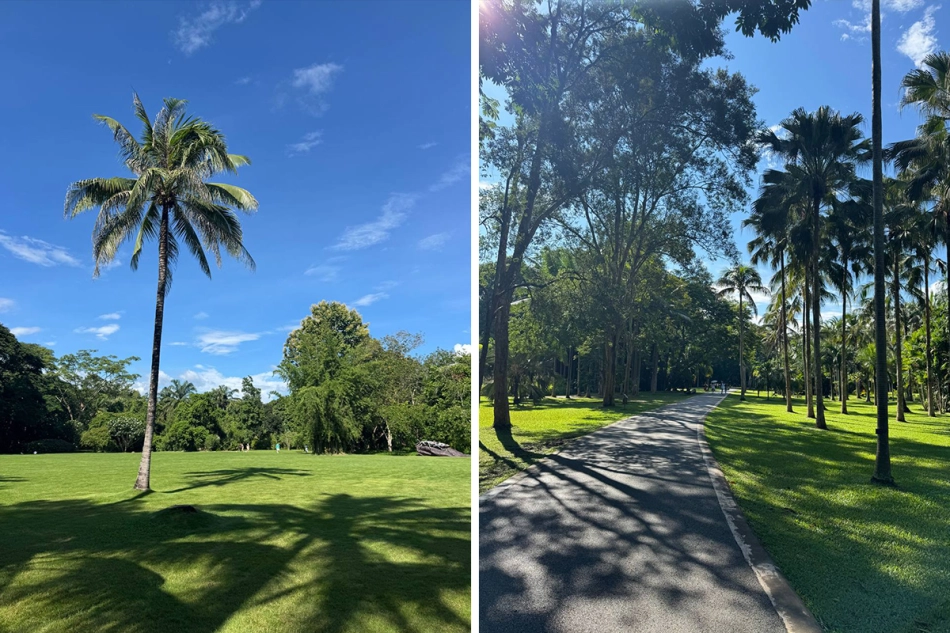
The most worthwhile place to visit in Xishuangbanna is the Chinese Academy of Sciences Tropical Botanical Garden. It’s a directly affiliated public institution of the CAS, serving as a comprehensive research institution integrating scientific research, species conservation, and science popularization education, as well as a renowned scenic destination both domestically and internationally. The garden covers approximately 1,125 hectares, collects over 13,000 species of living plants, has 39 specialized plant zones, and preserves a primeval tropical rainforest of about 250 hectares — one of the largest botanical gardens in China by area, species richness, and number of specialized zones. But because it’s simply too large and the temperature was high, we only finished the East Zone before leaving the park.
Return Journey
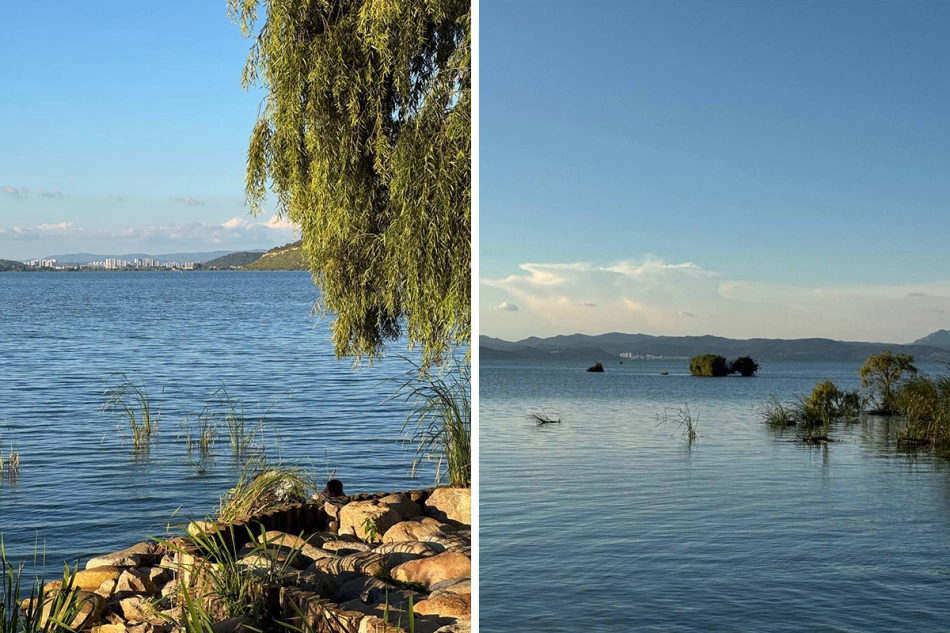
Xishuangbanna was our last stop. After charging up outside the Tropical Botanical Garden around 2-3 PM, we set off toward Kunming — our goal was to get back to Chengdu the next day. We tried to cover as much ground as possible today. Passing Kunming in the evening, the massive Dianchi Lake was bathed in brilliant blue sunlight, so we got off the expressway and lingered by the lake for a while.
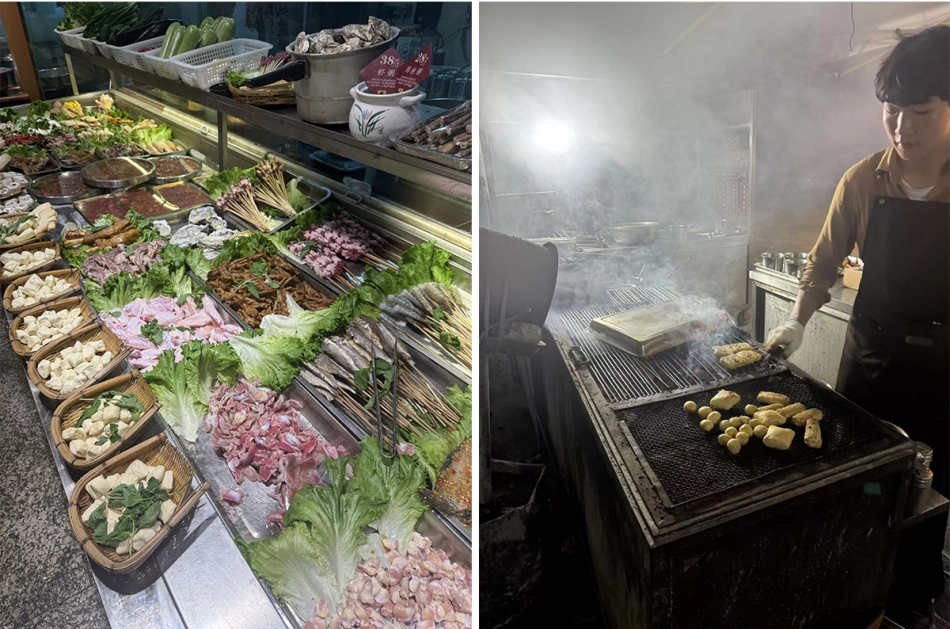
It wasn’t until past 9 PM that we found a place to stay in Xundian County town. We found the most popular Zhaotong-style BBQ to wrap up the day’s journey.
The next day we set off again at 10 AM. Along the way, we stopped at Hejiangmen in Yibin to feed the fish, and finally got home at 8 PM.
Transportation Summary
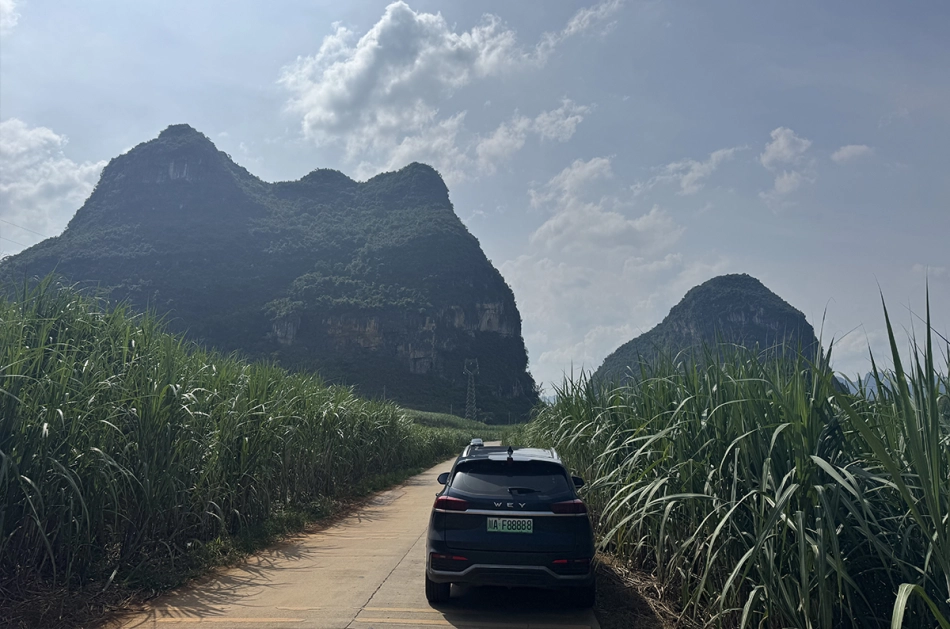
Our vehicle is a Great Wall dual-mode plug-in hybrid DHT-PHEV with four-wheel drive. This trip lasted 12 days total, starting with a zeroed odometer. Total distance driven: 4,891 km. Fuel cost: 1,948 yuan. Charging cost: 223 yuan. Unit fuel cost: 0.398 yuan/km. Comprehensive energy cost: 0.44 yuan/km. Very satisfied with the experience!
Tolls for the entire trip were approximately 2,600 yuan, bringing total transportation costs to 4,771 yuan. Hotel accommodations were roughly 2,000-3,000 yuan. We didn’t visit many ticketed attractions — probably around 1,000-2,000 yuan. Total trip cost was under 10,000 yuan.
Travel Reflections
I’ve developed a complete understanding of the Sichuan Basin. It’s no longer just elevation data on paper — it’s a real, tangible experience. Driving north before, crossing the Daba Mountains and Qinling, I knew the difficulty of the Shu roads. This time heading south, I felt dizzy from the high altitude in Kunming and Zhaotong, and the roads through the twisting Wumeng Mountains were limited to 80-100 km/h. Once we descended into Sichuan territory, suddenly the mountains seemed smaller, the roads straighter, and we could drive faster. To the west of the basin, of course, standing in Chengdu at 500 meters elevation, you can see Yaomei Peak at 6,247 meters. To the east, only the Three Gorges serves as an outlet for the basin’s water to flow out. The entire southwest region (Yunnan, Guizhou, Sichuan, Tibet) is like a well-kneaded ball of dough, and the Sichuan Basin is the depression you make when you punch your fist hard into it. Being able to live in such a small, precious piece of land, I feel especially fortunate.
Furthermore, comparing topography, landforms, and climate with the areas surrounding the basin (indeed the entire western China), Chengdu is a uniquely irreplaceable presence across this vast territory. These favorable factors determine Chengdu’s eternal economic position in the western region.