2014 Vietnam Travelogue
I went traveling — to Vietnam, during the Spring Festival.
The reason for going was simple: in order to have a passport ready so I could decide to go to Nepal — crossed off as item fourteen on my wish list — at any moment in the future, I went ahead and applied for one in advance (it took two trips back to my hometown county to finally get it done). After seeing what I’d done, Xiao Zhang also applied for a passport. Coincidentally, our passports became effective on the very same day. Like the impulse to rush into a scenic area the moment you’ve bought a ticket, she said, “Let’s go to Vietnam,” and I said, “Sure, it’s not expensive anyway.” Our fourteen-day Spring Festival holiday finally had a destination, and we’d also make up for missing Qinghai Lake during the National Day holiday.
Going to Vietnam had been her dream since college — perhaps influenced by some artsy film or artistic photo — she said the Vietnamese ao dai was beautiful. Perhaps under the incoherent rhetoric of “what’s national is universal,” we’ve all grown accustomed to viewing other ethnic groups’ customs with a neutral stance, generally believing that “if you think it’s ugly, it’s because you don’t understand it, you don’t understand that people’s culture; so you’ve made a wrong judgment; actually it’s very good and beautiful!” — this obsessive-compulsive conclusion. But Xiao Zhang wasn’t aesthetically obsessive; I, on the other hand, held firm to my own aesthetic tastes: China’s qipao, in every detail — its cut, fabric, and embroidery — already surpasses the ao dai. And a qipao worn by a woman is absolutely not a temptation that can be satisfied merely by gently running one’s hands along its clinging curves.
Before October, I had never imagined I’d visit Vietnam in my lifetime. Aside from knowing that Da Nang was beautiful, I had no interest in the country at all. So as departure approached, I hadn’t even prepared a decent itinerary. I told Xiao Zhang: “Let’s just wander — wherever we end up, that’s where we end up.”
Before Xiao Zhang returned to her hometown for work in July, we met up; in November there was also Xiao Luo, and we spent half a day together; and then came this trip — on the 28th she arrived in Chengdu, and after a long separation we were warmly catching up, sharing experiences on how to slip away from family during the Spring Festival.
That night we flew to Nanning. I had arranged for a girl I’d met on the Qinghai-Tibet Railway, Qing, to take us to eat laoyoufen (old friend noodles). I felt truly guilty — because of a flight delay, we didn’t arrive in downtown Nanning until midnight, ruining her sweet dreams. After that, she took us to Zhongshan Road to experience the local street food. At the T-junction on Zhongshan Road, in front of the honey-glazed pork rib stall that Qing recommended as the best, Xiao Zhang stared at Qing for a good while before saying she looked a lot like Sanmao. I probably wouldn’t notice who resembles whom in my entire life, but Qing really did look like her. The honey-glazed ribs were delicious too.
Our first meal was laoyoufen, recommended by Qing. But my college roommate, a Nanning local, had spent four years raving about Guangxi’s signature dish being luosifen (snail rice noodles). My goodness — he was recommending Liuzhou’s specialty! And he was from Nanning!! Laoyoufen is made by first stir-frying a jumble of ingredients in a wok, then mixing them with the noodles into a bowl. The taste was rather peculiar, with a slightly sour tang. If not for everyone around me eating with such relish, I would’ve thought the ingredients were unhygienic. Fortunately, after eating it two or three times, I got used to it. Nanning also has pickled fruit, available in sweet and sour varieties. The sweet kind is passable, but the sour kind is truly bizarre.
The next day, we took an international bus from Langdong Bus Station to Hanoi — a seven-hour journey costing 168 yuan, including the half-hour-plus at the Friendship Pass border checkpoint. After clearing customs, we switched to another bus. The coach traveled along a two-lane highway, and through the window I saw lush little hills, colorful Vietnamese-style buildings, and more and more people on motorbikes wearing green conical hats. Occasionally we passed through towns where streetsides were lined with countless kumquats and chrysanthemums for sale — just like the Spring Festival customs in Guangdong.
We didn’t arrive in Hanoi until 9 PM. Following other passengers from our bus, we slipped out to Hanoi’s iconic landmark — Hoan Kiem Lake. Oh my! It was basically a small pond, surrounded by a ring of neon lights, and yet it was packed with people. Well, this was Hanoi’s city center. After Xiao Zhang and I found our accommodation and had a bowl of some unnameable noodle soup, we went back to Hoan Kiem Lake for another walk, chatting about her love life and my crushes, just like the young Vietnamese people around us. We didn’t plan to stay long and booked flights to Ho Chi Minh City for the next day — Vietjet Air was only a little over 500 RMB per person. Later we learned this was Vietnam’s cheapest airline, and it didn’t provide complimentary meals.
Long before the plane approached Ho Chi Minh City, we could already see vast expanses of urban sprawl. The buildings weren’t tall but were neatly arranged, stretching from the bay all the way to Tan Son Nhat Airport within the city. Stepping off the plane, we were hit by a heatwave of over 30 degrees. Fortunately I’d checked the weather beforehand and boarded in a T-shirt, while Xiao Zhang’s coat draped over her arm clearly betrayed that she’d just flown in from the north.
Ho Chi Minh City’s most famous tourist hub is Pham Ngu Lao Street (范五老街). I’m not sure how to spell it in Vietnamese, but when I pronounced it in Chinese, the taxi driver actually understood and dropped us off there. Although it might seem silly to judge this way, Vietnamese does indeed share many similar-sounding words with Chinese.
Please forgive my pretentiousness, nostalgia, and eagerness to show off after reading The Lover — from here on I’ll refer to “Ho Chi Minh City” by its old name, “Saigon.” I also hold a conviction: folk customs habitually violated by politics will eventually be vindicated. Saigon is no exception — once the Communist Party of Vietnam falls, this city will surely reclaim its original name. Here are two examples: Stalingrad was called “Tsaritsyn” before 1925, “Stalingrad” from 1925 to 1961, and “Volgograd” after 1961. In 2013, to commemorate the famous Battle of Tsaritsyn that Stalin led here in 1918, “Volgograd” is renamed “Stalingrad” on six commemorative days each year. Additionally, Zhongshan City, named after the founding father Sun Yat-sen, has only a little over a million residents, and his portrait is only displayed on Tiananmen Square once a year on October 1st. See — six days a year and a small prefecture-level city is the appropriate measure for commemorating a famous historical figure and a revolutionary who led a nation’s progress. Ho Chi Minh’s significance in Vietnamese history has undoubtedly been exaggerated.
In Saigon, you could rent a motorbike for about five or six US dollars. I originally told the hostel owner I wanted a white Vespa-style scooter, but he quietly left me with an ordinary Honda — the kind you see everywhere on every street. It was disappointing, but I couldn’t be bothered to argue. If Chengdu hadn’t banned motorcycles, I might have already bought the Vespa knockoff I’d been eyeing for years.
“Any travel not aimed at experiencing natural scenery is a scam” — this has been my declaration on the meaning of travel countless times, and it’s also why every trip I take is bound to be arduous. My wish list includes trekking in Nepal and cycling around Qinghai Lake — enjoying the scenery while also enduring physical and mental self-torture. Although a recent odd report suggested that when people are pushed to the brink of endurance and mental breakdown, they are closest to the divine, I don’t pursue that.
Xiao Zhang wore a backless spaghetti-strap dress with vertical stripes in red, white, and green, her long hair cascading over her shoulders. Under the sea-blue sunshine at 10 degrees north latitude, she radiated youth and artistic flair, and my heart couldn’t help but flutter. At that moment, she was a vacationer who had traveled far; and I, wearing a plain grayish-white T-shirt paired with slightly scuffed jeans and earthy-yellow New Balance suede sneakers, was the picture of a backpacker. To outsiders, we must have looked like an odd travel duo, but I hadn’t realized it — and from the start, I hadn’t really pondered her travel mindset either.
Only by joining Saigon’s motorbike swarm can you truly integrate into their daily life. Riding this Honda, I imagined myself in a Roman Holiday scenario, carrying Xiao Zhang careening through Saigon. Unable to read the street names on the map, I simply rode toward Saigon’s tallest building, the Bitexco Financial Tower. Although this building wasn’t even as tall as my office in Chengdu, it stood out like a crane among chickens in Saigon — visible from anywhere in the city. I thought that must be the city center, but when I got there, it was just like anywhere else in China — no miracle.
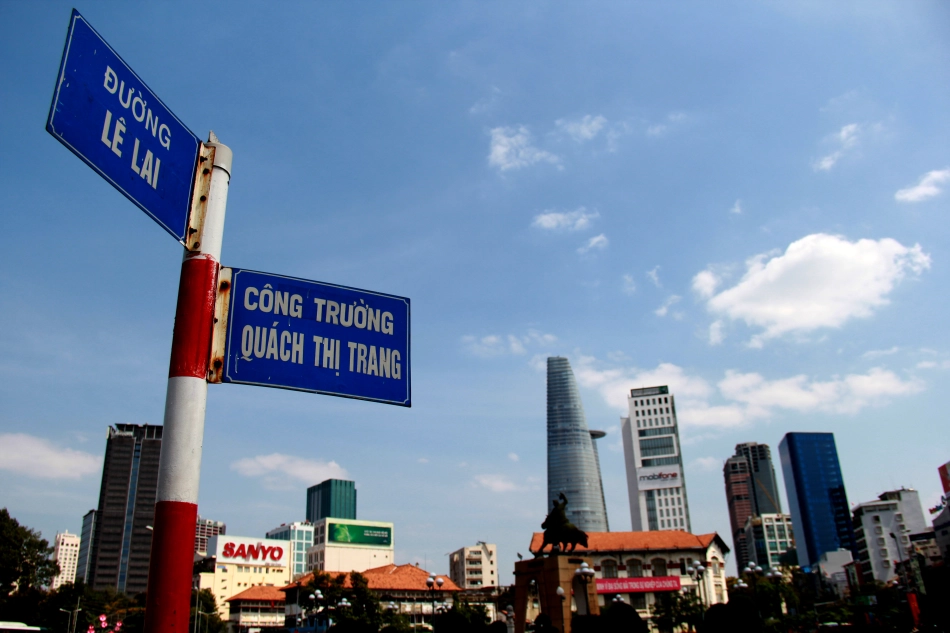
Beside the Financial Tower flowed the endlessly surging Mekong River. I leaned on the railing and gazed for a long time — in my entire life I had never seen such a wide river. Even before this, apart from Erhai Lake and Dianchi Lake, I hadn’t even seen the sea. The Mekong originates on the Qinghai-Tibet Plateau and is called the Lancang River in China. In October 2012, I had passed through the Lancang River in Deqin County. The river channel was narrow, the water muddy yellow, the current turbulent, and the roaring sound was so powerful it felt like it could suck me in — truly terrifying. After flowing thousands of kilometers and settling its sediment at power stations along the way, the Mekong in Saigon had become broad and calm. There was a port along the bank, and a seagoing vessel was unloading cargo. At that moment I thought of the film The Lover — the female protagonist, at a similar spot, forever left Vietnam, left her lover behind. In a few days I too would leave Vietnam, not knowing what feelings I’d carry with me, and a wave of melancholy washed over me.
Looking toward the Mekong River delta, I spotted a tall bridge rising in the distance and suggested we go take a look.
It was a towering bridge, and from it you could see ships slowly gliding across the river in the distance. After crossing the bridge, we suddenly found ourselves in the countryside — the roads were broken and muddy, chickens and ducks and kids playing football were everywhere, and the houses on both sides were low and dilapidated, much like slums in Chinese cities. The people on the road looked at Xiao Zhang and me with indifference. I felt a hint of fear, twisted the throttle harder, and sped through.
As the sun set, we’d been riding for nearly two hours and still hadn’t made it back to the city from this rural area. Xiao Zhang was tired from sitting in the back, slumped against my back and making my neck ache. I said, “Don’t you think it’s heartwarming, watching those young couples on motorbikes rushing home in the setting sun?” She mhm’d, and I continued, “We’re heading back to the city too — why don’t you learn from those young women on the bikes behind and just hold onto me?” Then Xiao Zhang punched me in the back — hard!